
Contents
Overview
The genesis of CT scanning can be traced back to the pioneering work of Sir Godfrey Hounsfield and Allan Cormack, who independently conceived of and developed the technology. Hounsfield, an engineer at EMI Limited, built the first CT scanner. Cormack, a physicist at Tufts University, had theorized the mathematical principles behind reconstructing images from X-ray projections. Their groundbreaking contributions earned them the Nobel Prize in Physiology or Medicine in 1979, cementing CT's place as a transformative medical technology. Early CT scanners were slow and produced low-resolution images, requiring hours to scan a single slice, a stark contrast to today's rapid, multi-detector systems.
⚙️ How It Works
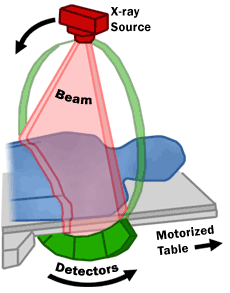
At its core, a CT scanner operates by encircling the patient with an X-ray tube that emits a fan-shaped beam. As this beam rotates around the body, detectors positioned opposite the X-ray source measure the degree to which the X-rays are attenuated (absorbed or scattered) by different tissues. This process generates thousands of individual measurements for each slice. Sophisticated computer algorithms, such as the filtered back-projection algorithm, then process these measurements to reconstruct a detailed cross-sectional image, effectively creating a 'slice' of the body. Modern scanners utilize multiple detector rows, allowing for faster scanning and the acquisition of volumetric data, which can be reformatted into sagittal and coronal views, offering a comprehensive 3D perspective.
📊 Key Facts & Numbers
The scale of CT imaging is staggering. A single CT scan can generate hundreds to thousands of images, each typically 1-10 millimeters thick, resulting in gigabytes of data per examination.
👥 Key People & Organizations
Key figures in the development and advancement of CT imaging include Sir Godfrey Hounsfield, the primary inventor of the first clinical CT scanner, and Allan Cormack, whose theoretical work laid the mathematical foundation. Companies like General Electric Healthcare, Siemens Healthineers, and Philips Healthcare are titans in the manufacturing and innovation of CT scanner technology, investing billions in research and development. Radiologists, such as Dr. Daniel Miller, a leading expert in CT interpretation, play a crucial role in analyzing the complex images and making diagnoses. Professional organizations like the Radiological Society of North America (RSNA) and the American College of Radiology (ACR) set standards, promote education, and advocate for the responsible use of CT technology.
🌍 Cultural Impact & Influence
CT scanning has profoundly reshaped medical diagnosis and patient care, becoming a cornerstone of modern healthcare. Its ability to visualize internal injuries rapidly has made it indispensable in emergency medicine and trauma care, dramatically improving outcomes for patients with critical conditions. The technology's influence extends beyond diagnosis; it's used in interventional radiology for guiding biopsies and treatments, and in radiation oncology for precise tumor targeting. Culturally, CT scans have entered the public consciousness, often depicted in medical dramas and news reports as a symbol of advanced medical technology, though sometimes contributing to anxieties about radiation exposure. The widespread adoption of CT has also spurred advancements in related fields like medical physics and computer science, particularly in image processing and artificial intelligence.
⚡ Current State & Latest Developments
The current landscape of CT imaging is characterized by rapid technological evolution, particularly in areas of artificial intelligence (AI) and dose reduction. AI algorithms are increasingly being integrated into CT workflows for tasks such as image reconstruction, artifact reduction, and automated detection of abnormalities, with companies like Aidoc and Im-AI-Tech leading the charge. Dual-energy CT, which uses two X-ray energy levels simultaneously, is becoming more prevalent, offering enhanced material differentiation for improved diagnosis of conditions like kidney stones and pulmonary embolisms. Furthermore, iterative reconstruction techniques, which replace or supplement traditional filtered back-projection, are now standard, significantly reducing radiation doses while maintaining image quality. The development of photon-counting CT scanners promises even greater spectral information and reduced noise, pushing the boundaries of diagnostic clarity.
🤔 Controversies & Debates
A significant controversy surrounding CT imaging revolves around radiation exposure. This has led to ongoing debates about appropriate utilization, the need for justification of every scan, and the implementation of dose optimization strategies, often referred to as ALARA (As Low As Reasonably Achievable). Another area of contention is the potential for overdiagnosis, where incidental findings on CT scans, often detected due to increased sensitivity and widespread screening, may lead to unnecessary follow-up procedures and patient anxiety. The ethical implications of AI in CT interpretation also present challenges, including algorithmic bias and accountability for diagnostic errors.
🔮 Future Outlook & Predictions
The future of CT imaging is poised for further integration with AI, leading to more automated and personalized diagnostic pathways. Expect AI to play an even larger role in image acquisition, reconstruction, and interpretation, potentially enabling real-time diagnostic feedback during scans. Photon-counting CT technology is expected to become more widespread, offering unprecedented spectral information that could revolutionize the detection and characterization of diseases. Furthermore, advancements in portable and lower-dose CT systems may expand access to this technology in resource-limited settings and point-of-care applications. The convergence of CT with other imaging modalities and clinical data through advanced informatics platforms will likely lead to more comprehensive patient assessments and precision medicine approaches.
💡 Practical Applications
CT scanning's practical applications are vast and critical. In medicine, it's used for diagnosing acute conditions like stroke and appendicitis, staging cancers, evaluating trauma, and guiding minimally invasive procedures. In industry, CT is employed for non-destructive testing of materials, quality control in manufacturing, and inspecting components for defects. Archaeologists and art historians use CT to examine artifacts and artworks without damaging them, revealing hidden details or internal structures. For example, CT scans have been used to analyze ancient mummies, revealing details about their health and preservation methods, and to inspect the structural integrity of historical buildings. The technology also finds use in security screening at airports and in forensic investigations.
Key Facts
- Category
- technology
- Type
- topic