
Contents
Overview
The quest for new medicines has a history stretching back millennia, initially rooted in empirical observation of traditional remedies and accidental discoveries. Ancient Egyptians used willow bark for pain relief, a precursor to modern acetylsalicylic acid. The isolation of morphine from opium in the 1800s marked an early triumph of chemical analysis. A pivotal moment arrived in 1928 with Alexander Fleming's accidental discovery of penicillin, ushering in the antibiotic era and demonstrating the power of serendipity. The mid-20th century saw the rise of classical pharmacology, focusing on screening natural products and synthetic compounds against whole organisms or cells to find therapeutic effects. This era laid the groundwork for the pharmaceutical industry as we know it, with companies like Pfizer and Merck & Co. becoming pioneers in systematic drug development.
⚙️ How It Works
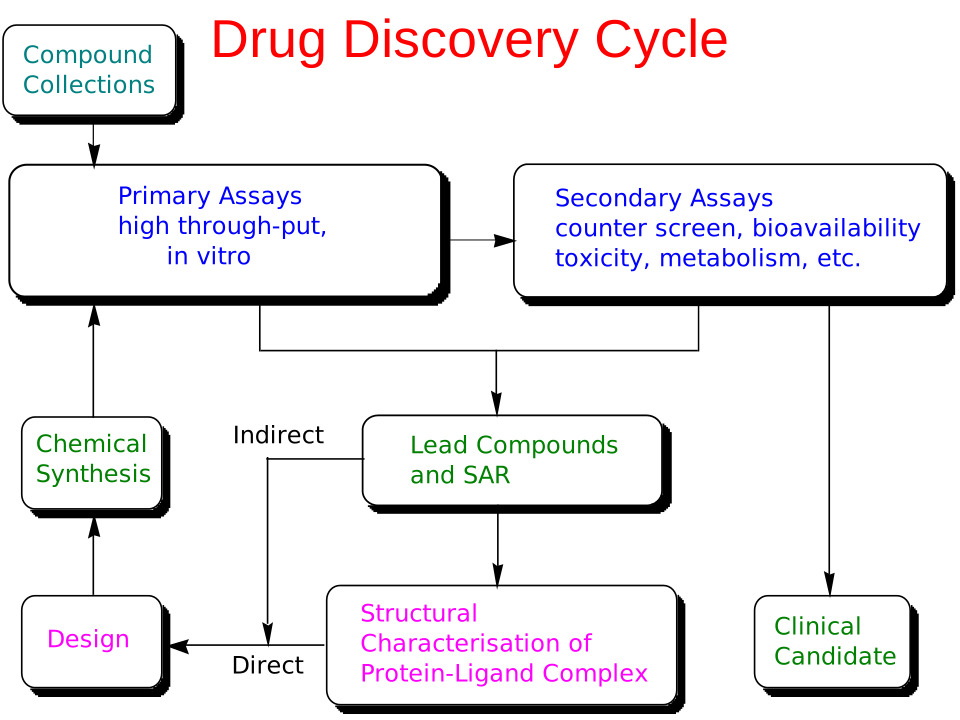
Modern drug discovery typically begins with target identification, pinpointing a specific molecule (like a protein or enzyme) believed to play a critical role in a disease. This is followed by high-throughput screening (HTS), where automated systems test millions of compounds from chemical libraries against the target. Hits that show activity are then subjected to lead optimization, a rigorous process of medicinal chemistry to improve potency, selectivity, and drug-like properties (absorption, distribution, metabolism, excretion – ADME). Promising leads enter preclinical testing, involving in vitro and in vivo studies (cell cultures and animal models) to assess safety and efficacy. Successful preclinical candidates then advance to clinical trials in humans, a multi-phase process to confirm safety and effectiveness, before potential regulatory approval by bodies like the U.S. Food and Drug Administration.
📊 Key Facts & Numbers
The financial stakes in drug discovery are astronomical. Developing a single new drug can cost upwards of $2.6 billion, according to a 2019 Tufts Center for the Study of Drug Development report. The success rate from initial discovery to market approval is notoriously low, often cited as less than 10%. On average, it takes 10-15 years for a drug to navigate the entire discovery and development pipeline. Pharmaceutical companies invest billions annually; for instance, Johnson & Johnson reported $14.7 billion in R&D spending in 2023. Of the thousands of compounds screened, only a handful make it to clinical trials, and even fewer gain regulatory approval.
👥 Key People & Organizations
Pioneering figures like Gertrude B. Elion and George H. Hitchings, Nobel laureates for their work on rational drug design, revolutionized the field by moving beyond serendipity towards a more scientific approach. Organizations such as the National Institutes of Health (NIH) fund critical early-stage research, while major pharmaceutical giants like Roche, Novartis, and AstraZeneca drive much of the late-stage development and commercialization. The rise of biotechnology firms, including Genentech (now part of Roche), has also been instrumental, often focusing on novel modalities like biologics and gene therapies.
🌍 Cultural Impact & Influence
The impact of successful drug discovery on global health is immeasurable, eradicating diseases, extending lifespans, and improving quality of life. The development of antibiotics like penicillin transformed infectious disease treatment, while vaccines for polio and smallpox represent monumental public health victories. The discovery of statins has dramatically reduced cardiovascular disease mortality. Conversely, the high cost and slow pace of drug discovery can lead to public frustration and debates about access to life-saving treatments, particularly for rare diseases or conditions affecting less profitable markets. The very definition of 'disease' can also be influenced by what is discoverable and treatable, shaping medical priorities.
⚡ Current State & Latest Developments
The current landscape of drug discovery is rapidly evolving, driven by advancements in artificial intelligence (AI) and machine learning. AI algorithms are being deployed to accelerate target identification, predict compound efficacy, and design novel molecules, as seen with companies like Recursion Pharmaceuticals and Exscientia. The focus is also shifting towards personalized medicine, tailoring treatments based on an individual's genetic makeup, and exploring new therapeutic modalities such as mRNA technology (popularized by BioNTech and Moderna) and CRISPR gene editing. The COVID-19 pandemic dramatically showcased the potential for accelerated development, with mRNA vaccines moving from concept to global deployment in under a year.
🤔 Controversies & Debates
Significant controversies surround the drug discovery process, primarily concerning the exorbitant costs and the resulting high prices of medications. Critics argue that the 'billions' spent on R&D are inflated by marketing costs and that pharmaceutical companies prioritize profitable 'me-too' drugs over truly innovative treatments for unmet medical needs. The patent system, while intended to incentivize innovation, is also debated for potentially stifling competition and prolonging monopolies. Ethical concerns also arise regarding the design and execution of clinical trials, particularly in developing nations, and the transparency of data reporting from pharmaceutical companies to regulatory bodies like the U.S. Food and Drug Administration.
🔮 Future Outlook & Predictions
The future of drug discovery is increasingly intertwined with computational biology and AI. Predictive models promise to significantly reduce the time and cost of identifying viable drug candidates, potentially shortening the 10-15 year timeline. We can expect a surge in treatments for rare genetic disorders through gene therapy and RNAi technologies. The integration of real-world evidence (RWE) from electronic health records and wearables will likely refine clinical trial design and post-market surveillance. However, the challenge of translating these advancements into affordable, accessible treatments for all remains a critical hurdle, with ongoing debates about pricing and intellectual property rights.
💡 Practical Applications
Drug discovery's practical applications are vast, forming the bedrock of modern medicine. Beyond pharmaceuticals, the methodologies and technologies developed—such as HTS and advanced analytical chemistry—have found applications in other fields, including agriculture (pesticides, herbicides) and materials science. The understanding gained from studying disease targets has also informed the development of diagnostic tools and biomarkers for early disease detection. Furthermore, the infrastructure built for drug discovery, including specialized laboratories and computational platforms, supports broader scientific research and innovation across the life sciences.
Key Facts
- Category
- science
- Type
- concept