
Contents
Overview
The conceptual seeds of frequency domain analysis were sown in the early 19th century with the work of Joseph Fourier, whose eponymous transform revealed that complex periodic waveforms could be decomposed into a sum of simple sine waves. This groundbreaking insight, published in his 1822 treatise Théorie analytique de la chaleur, provided a powerful new lens for understanding phenomena like heat diffusion. Prior to Fourier, mathematicians like Leonhard Euler and d'Alembert had explored wave phenomena, but it was Fourier's rigorous mathematical framework that truly established the frequency domain as a distinct analytical space. Early applications were primarily in physics and mathematics, but the advent of electrical engineering in the late 19th and early 20th centuries, particularly with the study of AC circuits by pioneers like Charles Proteus Steinmetz, propelled frequency domain analysis into widespread engineering practice.
⚙️ How It Works
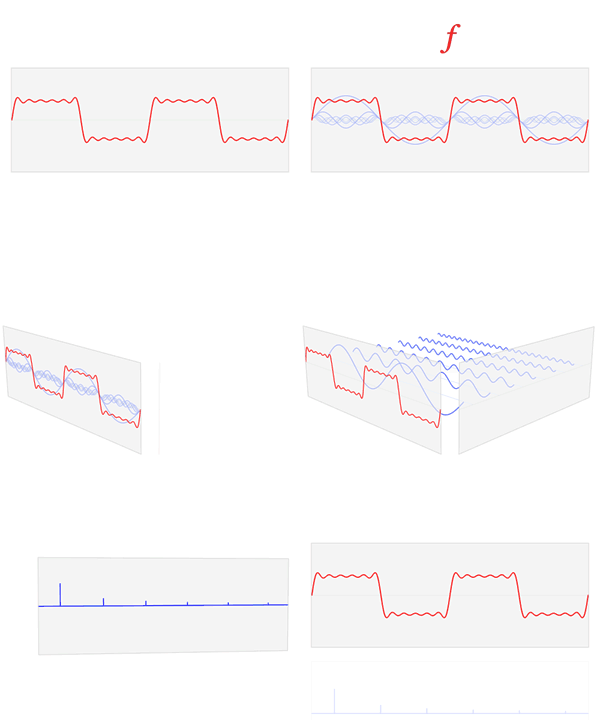
Analyzing a signal in the frequency domain involves transforming it from its time-domain representation into a spectrum of frequencies. The most common method is the Fourier Transform, which decomposes a signal into its constituent sine waves and cosine waves of different frequencies and amplitudes. The result is a representation showing the magnitude and phase of each frequency component. For non-periodic signals, the Fourier Series is extended to the Fourier Transform, which yields a continuous spectrum. The Laplace Transform is another crucial tool, particularly for analyzing transient responses and stability in control systems, as it can handle signals that grow exponentially. The Z-transform serves a similar purpose for discrete-time signals, mapping them into the complex z-plane. These transforms allow engineers to visualize and manipulate signal characteristics like bandwidth, harmonic distortion, and resonance with unprecedented clarity.
📊 Key Facts & Numbers
A typical audio signal, like speech, can contain frequencies ranging from approximately 300 Hz to 3.4 kHz for standard telephony, but human speech can extend up to 8 kHz. The Wi-Fi standard 802.11ac operates in the 5 GHz band, with channel bandwidths of up to 160 MHz. A single terahertz (THz) (10^12 Hz) wave can carry more than 1000 times the data of a typical gigahertz (GHz) wave. The human ear is sensitive to frequencies between 20 Hz and 20 kHz, a range known as the audible spectrum. In astronomy, the Cosmic Microwave Background radiation exhibits temperature fluctuations with characteristic angular scales corresponding to specific multipoles (l values) in its frequency spectrum, with the dominant peak around l=220. The GPS relies on signals in the L-band, around 1.227 GHz and 1.575 GHz, to triangulate positions with accuracy often within 3-5 meters.
👥 Key People & Organizations
The foundational work on Fourier Transform analysis is inextricably linked to Joseph Fourier, a French mathematician and physicist whose 1822 treatise laid the groundwork. In electrical engineering, Charles Proteus Steinmetz was instrumental in developing methods for analyzing AC circuits using complex numbers, effectively introducing frequency domain concepts to the field in the late 19th century. Later, Harry Nyquist and Claude Shannon developed the Nyquist-Shannon sampling theorem, a critical link between time and frequency domains for digital signal processing. In control systems, figures like Harold Black, inventor of the negative feedback amplifier, and Rudolf E. Kálmán, developer of the Kalman filter, relied heavily on frequency domain analysis. Organizations like the IEEE and its various societies, such as the IEEE Signal Processing Society, are central to advancing research and standards in this area.
🌍 Cultural Impact & Influence
The frequency domain has profoundly shaped modern technology and our understanding of the universe. It's the bedrock of radio communication, enabling everything from AM/FM broadcasts to 5G mobile networks by allowing signals to be modulated and filtered. In audio engineering, it's essential for designing equalizers, understanding acoustics, and producing music, allowing for precise manipulation of tonal balance. Medical imaging techniques like Magnetic Resonance Imaging (MRI) rely on analyzing the frequency responses of atomic nuclei. Even in fields like economics, spectral analysis has been applied to identify cyclical patterns in financial markets. The ability to 'see' the frequency content of signals has unlocked countless innovations, making it a ubiquitous concept in scientific and engineering culture.
⚡ Current State & Latest Developments
The ongoing miniaturization of electronic components continues to push the boundaries of frequency domain analysis into higher and higher spectral ranges, particularly into the terahertz (THz) gap, promising new frontiers in high-speed communication and sensing. Advancements in machine learning and artificial intelligence are enabling more sophisticated and automated spectral analysis, allowing for the identification of complex patterns in noisy data that were previously undetectable. The development of software-defined radio (SDR) platforms has democratized access to frequency domain tools, allowing researchers and hobbyists to experiment with a wide range of signals. Furthermore, new algorithms for Fast Fourier Transform (FFT) and related spectral estimation techniques are constantly being developed to improve speed and accuracy, especially for real-time applications.
🤔 Controversies & Debates
One persistent debate revolves around the interpretation of spectral analysis in complex, non-linear systems. While the Fourier Transform is powerful for linear systems, its application to chaotic or highly non-linear phenomena can be challenging, leading to discussions about the adequacy of traditional frequency domain methods. Another point of contention can arise in digital signal processing regarding the trade-offs between frequency resolution and time resolution, as dictated by the uncertainty principle (analogous to Heisenberg's). The choice of spectral estimation method itself can also be debated, with different techniques (e.g., periodogram vs. Welch's method) offering different biases and variances, making the 'best' approach context-dependent. Furthermore, the interpretation of spurious spectral components, often arising from aliasing or leakage, requires careful consideration and can lead to disagreements.
🔮 Future Outlook & Predictions
The future of frequency domain analysis is increasingly intertwined with advancements in quantum computing and AI. Quantum algorithms promise to perform certain spectral analyses exponentially faster than classical methods, potentially revolutionizing fields like materials science and drug discovery. The continued exploration of the terahertz (THz) spectrum for communication and sensing is expected to yield significant breakthroughs, requiring new analytical tools and hardware. As data volumes explode, efficient and robust spectral analysis will be crucial for managing and extracting insights from vast datasets in areas like astronomy and genomics. The integration of
💡 Practical Applications
The frequency domain is a conceptual space where signals and systems are analyzed based on their constituent frequencies, rather than their temporal evolution. Instead of observing how a signal changes moment by moment (the time domain), we examine its amplitude and phase across a spectrum of frequencies. This transformation, typically achieved via mathematical tools like the Fourier Transform, reveals fundamental characteristics like bandwidth, resonance, and harmonic content that are often obscured in the time domain. It's a cornerstone of fields ranging from electrical engineering and signal processing to quantum mechanics and astronomy, enabling engineers and scientists to design filters, understand vibrations, and decode complex data. The insights gained from frequency domain analysis are critical for everything from tuning a musical instrument to designing advanced communication systems.
Section 11
Analyzing a signal in the frequency domain involves transforming it from its time-domain representation into a spectrum of frequencies. The most common method is the Fourier Transform, which decomposes a signal into its constituent sine waves and cosine waves of different frequencies and amplitudes. The result is a representation showing the magnitude and phase of each frequency component. For non-periodic signals, the Fourier Series is extended to the Fourier Transform, which yields a continuous spectrum. The Laplace Transform is another crucial tool, particularly for analyzing transient responses and stability in control systems, as it can handle signals that grow exponentially. The Z-transform serves a similar purpose for discrete-time signals, mapping them into the complex z-plane. These transforms allow engineers to visualize and manipulate signal characteristics like bandwidth, harmonic distortion, and resonance with unprecedented clarity.
Section 12
A typical audio signal, like speech, can contain frequencies ranging from approximately 300 Hz to 3.4 kHz for standard telephony, but human speech can extend up to 8 kHz. The Wi-Fi standard 802.11ac operates in the 5 GHz band, with channel bandwidths of up to 160 MHz. A single terahertz (THz) (10^12 Hz) wave can carry more than 1000 times the data of a typical gigahertz (GHz) wave. The human ear is sensitive to frequencies between 20 Hz and 20 kHz, a range known as the audible spectrum. In astronomy, the Cosmic Microwave Background radiation exhibits temperature fluctuations with characteristic angular scales corresponding to specific multipoles (l values) in its frequency spectrum, with the dominant peak around l=220. The GPS relies on signals in the L-band, around 1.227 GHz and 1.575 GHz, to triangulate positions with accuracy often within 3-5 meters.
Section 13
The foundational work on Fourier Transform analysis is inextricably linked to Joseph Fourier, a French mathematician and physicist whose 1822 treatise laid the groundwork. In electrical engineering, Charles Proteus Steinmetz was instrumental in developing methods for analyzing AC circuits using complex numbers, effectively introducing frequency domain concepts to the field in the late 19th century. Later, Harry Nyquist and Claude Shannon developed the Nyquist-Shannon sampling theorem, a critical link between time and frequency domains for digital signal processing. In control systems, figures like Harold Black, inventor of the negative feedback amplifier, and Rudolf E. Kálmán, developer of the Kalman filter, relied heavily on frequency domain analysis. Organizations like the IEEE and its various societies, such as the IEEE Signal Processing Society, are central to advancing research and standards in this area.
Section 14
The frequency domain has profoundly shaped modern technology and our understanding of the universe. It's the bedrock of radio communication, enabling everything from AM/FM broadcasts to 5G mobile networks by allowing signals to be modulated and filtered. In audio engineering, it's essential for designing equalizers, understanding acoustics, and producing music, allowing for precise manipulation of tonal balance. Medical imaging techniques like Magnetic Resonance Imaging (MRI) rely on analyzing the frequency responses of atomic nuclei. Even in fields like economics, spectral analysis has been applied to identify cyclical patterns in financial markets. The ability to 'see' the frequency content of signals has unlocked countless innovations, making it a ubiquitous concept in scientific and engineering culture.
Section 15
The ongoing miniaturization of electronic components continues to push the boundaries of frequency domain analysis into higher and higher spectral ranges, particularly into the terahertz (THz) gap, promising new frontiers in high-speed communication and sensing. Advancements in machine learning and artificial intelligence are enabling more sophisticated and automated spectral analysis, allowing for the identification of complex patterns in noisy data that were previously undetectable. The development of software-defined radio (SDR) platforms has democratized access to frequency domain tools, allowing researchers and hobbyists to experiment with a wide range of signals. Furthermore, new algorithms for Fast Fourier Transform (FFT) and related spectral estimation techniques are constantly being developed to improve speed and accuracy, especially for real-time applications.
Section 16
One persistent debate revolves around the interpretation of spectral analysis in complex, non-linear systems. While the Fourier Transform is powerful for linear systems, its application to chaotic or highly non-linear phenomena can be challenging, leading to discussions about the adequacy of traditional frequency domain methods. Another point of contention can arise in digital signal processing regarding the trade-offs between frequency resolution and time resolution, as dictated by the uncertainty principle (analogous to Heisenberg's). The choice of spectral estimation method itself can also be debated, with different techniques (e.g., periodogram vs. Welch's method) offering different biases and variances, making the 'best' approach context-dependent. Furthermore, the interpretation of spurious spectral components, often arising from aliasing or leakage, requires careful consideration and can lead to disagreements.
Section 17
The future of frequency domain analysis is increasingly intertwined with advancements in quantum computing and AI. Quantum algorithms promise to perform certain spectral analyses exponentially faster than classical methods, potentially revolutionizing fields like materials science and drug discovery. The continued exploration of the terahertz (THz) spectrum for communication and sensing is expected to yield significant breakthroughs, requiring new analytical tools and hardware. As data volumes explode, efficient and robust spectral analysis will be crucial for managing and extracting insights from vast datasets in areas like astronomy and genomics. The integration of
Key Facts
- Category
- science
- Type
- topic