
Contents
Overview
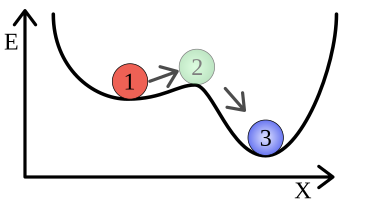
Global stability refers to the condition where the interconnected systems of human society and the Earth's environment are resilient to shocks and capable of sustained, peaceful coexistence. It encompasses political, economic, social, and ecological dimensions, aiming for a state free from widespread conflict, systemic collapse, or irreversible environmental degradation. Achieving global stability involves managing complex interdependencies, mitigating existential risks like climate change and nuclear proliferation, and fostering equitable development. The concept is not about static perfection but a dynamic equilibrium, where systems can absorb disturbances and adapt without fracturing. Its pursuit is a central, albeit often contentious, objective in international relations, economics, and environmental science, with ongoing debates about its definition, measurability, and attainability.
🎵 Origins & History
The conceptual roots of global stability can be traced back to ancient philosophical inquiries into order and chaos, but its modern formulation emerged in the wake of devastating global conflicts. The Cold War era introduced the concept of nuclear deterrence, a precarious form of stability based on mutually assured destruction, which paradoxically maintained peace between superpowers while fostering proxy conflicts. Early academic work in international relations and peace studies began to dissect the factors contributing to or detracting from this fragile global order, moving beyond mere absence of war to consider systemic resilience.
⚙️ How It Works
Global stability operates through a complex web of interlocking systems. Politically, it relies on established international norms, treaties, and institutions like the UN Security Council to manage disputes and enforce collective security. Economically, it hinges on stable global markets, predictable trade flows, and the absence of systemic financial crises, often managed by bodies like the IMF and the World Bank. Socially, stability is influenced by factors such as human rights, equitable distribution of resources, and the mitigation of widespread poverty and inequality, as addressed by SDGs. Ecologically, it requires maintaining planetary boundaries, such as stable climate patterns and biodiversity, to prevent cascading environmental collapses that could destabilize human societies. The interplay of these factors creates a dynamic equilibrium, where disruptions in one area can trigger ripple effects across others.
📊 Key Facts & Numbers
The scale of global instability is starkly illustrated by numerous metrics. The persistent challenge to political stability is highlighted by ongoing armed conflicts. The global economy, while growing, is susceptible to shocks. Climate change presents an existential threat, with global temperatures having already risen by approximately 1.1°C above pre-industrial levels, leading to increased frequency and intensity of extreme weather events. The global population now exceeds 8 billion, placing unprecedented strain on resources. Furthermore, the global debt has reached record highs, exceeding $300 trillion in 2023, a significant indicator of economic fragility.
👥 Key People & Organizations
Numerous individuals and organizations have shaped the discourse and practice of global stability. Kofi Annan, former UN Secretary-General, championed peacekeeping and development initiatives. Henry Kissinger, through his diplomatic realpolitik, profoundly influenced Cold War dynamics and international power balances. Organizations like the Stockholm International Peace Research Institute (SIPRI) provide critical data on conflict and arms control, while the World Economic Forum convenes global leaders to discuss systemic risks. Think tanks such as the Council on Foreign Relations and the Brookings Institution publish extensive research on geopolitical and economic stability. The IPCC serves as the authoritative voice on climate science, a critical component of ecological stability.
🌍 Cultural Impact & Influence
The pursuit of global stability has profoundly influenced global culture and consciousness. The widespread adoption of human rights discourse, largely driven by the Universal Declaration of Human Rights (1948), reflects a cultural aspiration for a more just and stable world order. International cooperation on issues like pandemics, exemplified by the WHO's role during the COVID-19 pandemic, demonstrates a shared understanding of interconnected vulnerabilities. Conversely, the persistent specter of global conflict, amplified by media coverage of wars and humanitarian crises, has fostered a global culture of anxiety and a demand for security. The rise of globalized media platforms like YouTube and X (formerly Twitter) also plays a dual role, disseminating information about global challenges while sometimes amplifying divisive narratives that undermine stability.
⚡ Current State & Latest Developments
The current state of global stability is characterized by significant flux and escalating challenges. Rising geopolitical tensions between the United States and China over trade, technology, and regional influence are reshaping global alliances. Climate change impacts are intensifying, with record-breaking heatwaves and extreme weather events becoming commonplace in 2023 and 2024. Meanwhile, democratic backsliding and the rise of authoritarianism in several regions, alongside persistent economic inequalities, contribute to social unrest and undermine institutional trust. The proliferation of disinformation campaigns, often amplified by social media, further erodes the foundations of stable governance.
🤔 Controversies & Debates
The concept of global stability is inherently controversial. A primary debate revolves around the definition itself: is stability the absence of conflict (a negative peace), or does it require positive conditions like justice, equity, and human flourishing (a positive peace)? Critics of the UN often point to its structural limitations, such as the Security Council veto, which can paralyze action on critical stability issues. Realist international relations theorists, like John Mearsheimer, argue that great power competition is an inherent feature of the international system, making lasting global stability an illusion and prioritizing national security over idealistic global governance. Furthermore, the pursuit of stability by powerful states can sometimes be perceived as imposing a particular order, leading to accusations of neo-colonialism or interference in sovereign affairs, as seen in debates surrounding interventions in Iraq and Libya.
🔮 Future Outlook & Predictions
The future outlook for global stability is uncertain, with competing forces at play. Projections from the Institute for Economics & Peace suggest that while the world has become less peaceful in recent years, the long-term trend could see improvement if key drivers of conflict are addressed. Technological advancements, particularly in AI and renewable energy, hold potential to both enhance stability (e.g., through efficient resource management, advanced early warning systems) and undermine it (e.g., through autonomous weapons, cyber warfare, or exacerbating economic inequality). The success of international cooperation in tackling climate change by 2030-2040 will be a critical determinant of long-term ecological and social stability. Some futurists predict a multipolar world order with shifting alliances, while others warn of increasing fragmentation and the potential for widespread systemic shocks.
💡 Practical Applications
Global stability has direct practical applications across numerous domains. In foreign policy, it informs strategies for diplomacy, peacekeeping operations, and international aid, aiming to prevent conflicts and rebuild post-war societies. Economic policy utilizes stability principles to manage inflation, regulate financial markets, and promote sustainable growth, often through coordination via institutions like the Bank for International Settlements. Envir
Key Facts
- Category
- philosophy
- Type
- topic