
Contents
Overview
Instability describes a state where a system's deviation from equilibrium amplifies over time, leading to unbounded growth or chaotic behavior. This fundamental concept spans physics, engineering, economics, and even social dynamics, illustrating how small perturbations can trigger catastrophic failures. In physics, instability is seen in the exponential divergence of trajectories in chaotic systems like weather patterns or the explosive release of energy in nuclear reactions. In structural engineering, instability is defined as the loss of load-carrying capacity, often manifesting as buckling in structures under compression. Economically, market bubbles and crashes exemplify instability, where herd behavior amplifies initial price movements. Socially, political instability can arise from cascading grievances or the breakdown of governance. Understanding instability is crucial for predicting, mitigating, and sometimes harnessing these powerful, often destructive, forces.
🎵 Origins & History
The concept of instability, while seemingly straightforward, has a rich and complex history rooted in the study of motion and equilibrium. The formalization of stability criteria, particularly in mechanics and celestial dynamics, gained momentum in the 18th and 19th centuries. The advent of thermodynamics introduced concepts like entropy, suggesting a universal tendency towards disorder and thus, instability. The 20th century saw the rise of chaos theory, which demonstrated that deterministic systems could exhibit extreme sensitivity to initial conditions, leading to unpredictable, unstable behavior. This evolution from static equilibrium to dynamic, often chaotic, instability reflects humanity's deepening understanding of the universe's inherent dynamism.
⚙️ How It Works
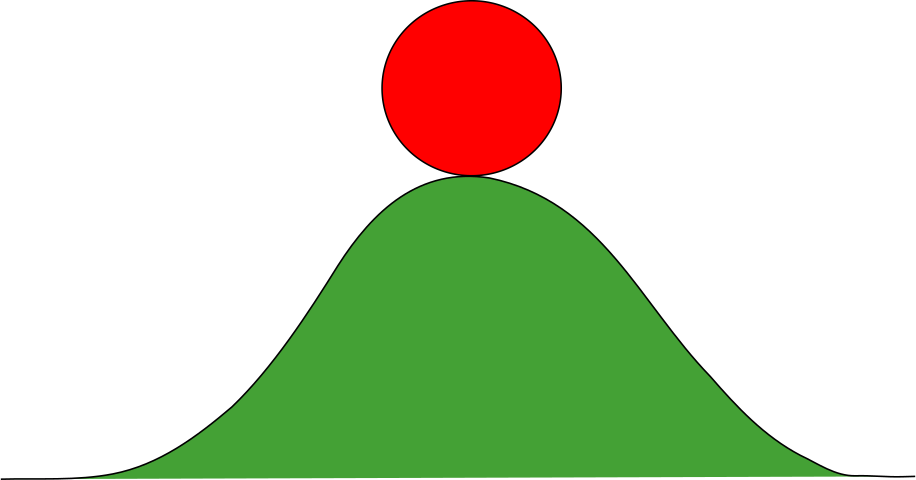
At its core, instability arises when a system's response to a perturbation is to amplify that perturbation. In a stable system, a small disturbance eventually decays, returning the system to its equilibrium state. For an unstable system, however, the deviation grows, often exponentially, pushing the system further away from equilibrium. This can manifest in several ways: in dynamical systems, instability manifests as diverging trajectories; in structural engineering, a load-bearing element like a column might buckle under compression, losing its ability to support weight; in economics, a minor price fluctuation can trigger a cascade of buying or selling, leading to a bubble or crash. The underlying mechanism often involves positive feedback loops, where the output of a process is fed back as input, reinforcing the initial change. For instance, in atmospheric science, warmer air rises, cools, condenses, releases latent heat, which warms the air further, causing it to rise even faster—a classic recipe for an unstable updraft that fuels thunderstorms.
📊 Key Facts & Numbers
The prevalence of instability is staggering, impacting systems across all scales. In physics, the Standard Model of particle physics predicts that the vacuum itself might be unstable under certain conditions, with a potential energy barrier to a lower state. The universe's expansion rate is subject to gravitational instabilities that seeded the formation of galaxies. In engineering, failures in structures under compression can occur at loads significantly below theoretical maximums. Economically, market bubbles and crashes exemplify instability. Even biological systems exhibit instability; a population of rabbits and foxes, modeled by the Lotka-Volterra equations, can exhibit cyclical population dynamics that, under certain parameters, become chaotic and unpredictable.
👥 Key People & Organizations
Numerous individuals and organizations have grappled with the concept of instability. The International Monetary Fund (IMF) and the Bank for International Settlements (BIS) continuously monitor and analyze global economic instability, publishing reports on systemic risks. Research institutions such as the Santa Fe Institute are hubs for studying complex adaptive systems, including their inherent instabilities. The National Academies of Sciences, Engineering, and Medicine frequently publish studies on structural and systemic vulnerabilities.
🌍 Cultural Impact & Influence
Instability has profoundly shaped human culture and understanding. The inherent unpredictability of natural phenomena like earthquakes, volcanic eruptions, and extreme weather has inspired myths, religions, and art throughout history, from the wrath of Poseidon to the existential dread in Edvard Munch's 'The Scream'. The concept of 'butterfly effect', popularized by Lorenz, has permeated popular culture, appearing in films like 'The Butterfly Effect' and countless science fiction narratives, highlighting how small actions can have massive, unforeseen consequences. In philosophy, the tension between order and chaos, stability and change, is a perennial theme. The pursuit of stability, whether in governance, finance, or personal life, is a driving force in human endeavor, yet the recognition of inevitable instability often leads to resilience and adaptation. The very notion of progress is often framed as overcoming or managing inherent instabilities.
⚡ Current State & Latest Developments
The study and management of instability are more critical than ever in the 21st century. Climate change is increasing the frequency and intensity of extreme weather events, pushing meteorological systems into more unstable regimes. Geopolitical tensions and the rise of disinformation campaigns contribute to significant political and social instability in numerous regions. In finance, the proliferation of high-frequency trading and complex derivatives introduces new forms of systemic risk, as demonstrated by flash crashes like the one on May 6, 2010, where the Dow Jones Industrial Average plunged nearly 1,000 points in minutes. Cybersecurity threats represent a constant battle against instability in digital infrastructure, with new vulnerabilities like Log4j exposing millions of systems. Researchers are continuously developing more sophisticated models to predict and mitigate these instabilities, from advanced climate modeling to AI-driven financial risk assessment.
🤔 Controversies & Debates
Debates surrounding instability often center on its predictability and controllability. A key controversy lies in the extent to which chaotic systems are truly unpredictable versus merely computationally intractable. While chaos theory demonstrates extreme sensitivity to initial conditions, some argue that underlying deterministic rules still offer a degree of long-term predictability, especially in aggregate behavior. Another debate concerns the role of human intervention: does attempting to stabilize systems, like economies or ecosystems, inevitably introduce new, unforeseen instabilities? Critics of central bank interventions, for example, argue that prolonged low interest rates create asset bubbles and moral hazard, sowing the seeds fo
Key Facts
- Category
- philosophy
- Type
- topic