
Contents
Overview
The lineage of the piston engine stretches back to antiquity, with early concepts like Hero of Alexandria's aeolipile in the 1st century AD demonstrating the principle of steam propulsion. The true genesis of practical piston engines lies with the Newcomen atmospheric engine, developed in England by Thomas Newcomen and John Calley. This early steam engine, primarily used for pumping water out of mines, was inefficient but revolutionary. James Watt's improvements in the 1760s and 1770s dramatically increased steam engine efficiency and versatility, paving the way for the Industrial Revolution. The 19th century saw the development of internal combustion engines, with pioneers like Étienne Lenoir creating the first commercially successful gas engine, followed by Nikolaus Otto's groundbreaking four-stroke cycle, a design that remains the foundation for most modern gasoline engines. Rudolf Diesel patented his compression-ignition engine, further expanding the capabilities of piston power.
⚙️ How It Works
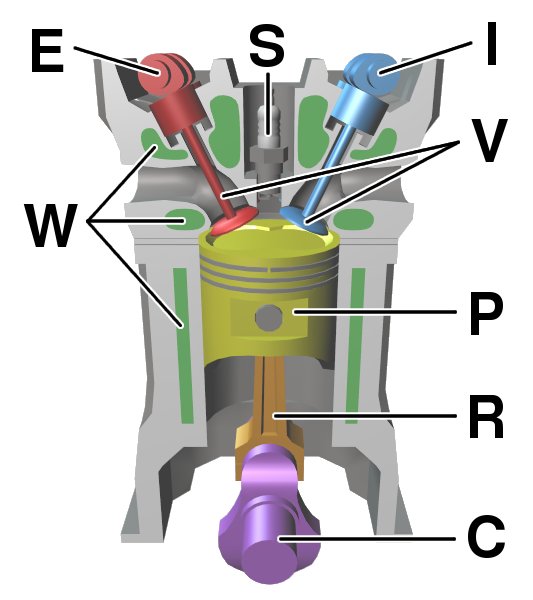
At its core, a piston engine operates on the principle of converting thermal energy into mechanical work through a cyclical process. In an internal combustion engine, a precisely measured mixture of fuel and air is introduced into a cylinder, compressed by a moving piston, and then ignited. The resulting explosion creates high pressure that forces the piston downward. This linear motion is translated into rotational motion by a connecting rod attached to a crankshaft. The piston then reverses direction, expelling exhaust gases and preparing for the next intake stroke. Steam engines operate similarly but use external heat to boil water, producing steam that drives the piston. The number of cylinders, their arrangement (inline, V, flat), and the timing of the strokes (two-stroke vs. four-stroke) dictate the engine's power delivery, efficiency, and operational characteristics, with modern engines often featuring complex valve timing systems and electronic controls managed by ECUs.
📊 Key Facts & Numbers
Piston engines are ubiquitous. Internal combustion engines, specifically, have achieved thermal efficiencies ranging from 20% for older gasoline engines to over 50% for advanced diesel and natural gas engines. The automotive sector accounts for a significant portion of all piston engine production. Modern engines often feature complex valve timing systems and electronic controls managed by ECUs.
👥 Key People & Organizations
Numerous individuals and organizations have shaped the piston engine's evolution. James Watt's innovations in steam engine technology were pivotal. Nikolaus Otto and Gottlieb Daimler are credited with developing the modern four-stroke internal combustion engine, with Wilhelm Maybach playing a key role in its refinement. Rudolf Diesel's invention of the compression-ignition engine revolutionized heavy-duty transport and industrial power. Major manufacturers like General Motors, Ford, Toyota, and Volkswagen have been instrumental in mass-producing and refining piston engines for global markets. Research institutions such as Massachusetts Institute of Technology and Ricardo continue to push the boundaries of engine efficiency and emissions control.
🌍 Cultural Impact & Influence
The piston engine has been a defining technology of the modern era, fundamentally altering transportation, industry, and warfare. The widespread adoption of automobiles powered by internal combustion engines in the early 20th century reshaped urban landscapes, enabled suburban sprawl, and created vast new industries. Steam engines powered the Industrial Revolution, driving factories, locomotives, and ships, and enabling unprecedented levels of production and global trade. The roar of a V8 engine has become an iconic sound in popular culture, featured in countless films, music, and racing events like the Indy 500. The piston engine's influence extends to aviation, with many early aircraft relying on them, and continues in applications like chainsaws, lawnmowers, and portable generators, embedding its mechanical pulse into daily life.
⚡ Current State & Latest Developments
As of 2024, piston engines face increasing pressure from electric vehicles (EVs). Manufacturers are heavily investing in hybrid powertrains, which combine piston engines with electric motors to improve fuel efficiency and reduce emissions. Significant research is underway to develop piston engines that can run on hydrogen or synthetic fuels, aiming to decarbonize existing infrastructure. Stricter emissions regulations, such as Euro 7 in Europe, are forcing continuous innovation in combustion control, exhaust after-treatment systems like catalytic converters, and diesel particulate filters. Companies like Achates Power are exploring advanced opposed-piston engine designs for improved efficiency.
🤔 Controversies & Debates
The environmental impact of piston engines, particularly their contribution to air pollution and climate change through greenhouse gas emissions like CO2 and NOx, is a major point of contention. While advancements in engine technology and emissions controls have significantly reduced per-vehicle pollution since the mid-20th century, the sheer number of piston engines in operation worldwide continues to pose environmental challenges. Debates persist regarding the pace of transition to zero-emission vehicles, the role of biofuels and synthetic fuels in mitigating emissions from existing engines, and the economic implications for industries reliant on internal combustion technology. The long-term viability of piston engines in a world increasingly focused on sustainability remains a subject of intense discussion.
🔮 Future Outlook & Predictions
The future of piston engines is likely to be one of coexistence and adaptation rather than outright extinction, at least in the medium term. Hybridization will continue to be a dominant trend, with piston engines serving as range extenders or primary power sources in conjunction with electric motors. The development of highly efficient, lean-burn engines capable of running on alternative fuels like hydrogen, ammonia, or advanced biofuels is a key area of research, potentially allowing piston engines to persist in sectors where electrification is challenging, such as heavy-duty transport and aviation. Opposed-piston engine designs, which offer higher thermal efficiency and reduced friction, are being revisited by companies like Achates Power as a potential pathway to cleaner, more efficient combustion. However, the long-term trajectory clearly favors electrification for passenger vehicles, with many jurisdictions setting targets for phasing out new internal combustion engine sales by 2030-2040.
💡 Practical Applications
Piston engines are integral to a vast array of practical applications. The most prominent is their use in automobiles, trucks, and buses,
Key Facts
- Category
- technology
- Type
- topic