
Contents
Overview
The lineage of United States customary units traces directly back to the English units of measurement prevalent in the British Empire before the American Revolution. As the nascent United States established its own standards, these inherited units formed the bedrock of the new system. A pivotal moment arrived in 1832 when the U.S. Treasury Department, under Secretary Levi Woodbury, adopted a uniform set of standards for weights and measures, largely based on existing English practices. This marked the formalization of what would become the USCS. However, the United Kingdom's own system underwent significant evolution, leading to the adoption of the British imperial system in 1824. This divergence meant that while many units remained similar in name and concept, their precise definitions, especially for liquid and dry volumes, began to diverge. Key definitions of USCS were later refined against the meter and kilogram, a definition later refined by the international yard and pound agreement in 1959, which established the current, precise conversion factors.
⚙️ How It Works
At its core, the USCS is a coherent system of weights and measures, though its units often lack the direct decimal relationships characteristic of the metric system. Length is measured using inches, feet, yards, and miles, with standard conversions like 12 inches to a foot and 5,280 feet to a mile. Area is derived from these linear units, yielding square inches, square feet, acres, and square miles. Volume, particularly for liquids, is quantified in fluid ounces, cups, pints, quarts, and gallons, with a distinct U.S. liquid gallon differing from its imperial counterpart. Dry volume uses a separate set of measures, including pints, quarts, and gallons, which are larger than their liquid equivalents. Weight is expressed in ounces, pounds, and tons, with the avoirdupois system being the most common. These units are interconnected through specific conversion factors, such as 16 ounces to a pound and 2,000 pounds to a short ton (the standard ton in the U.S.).
📊 Key Facts & Numbers
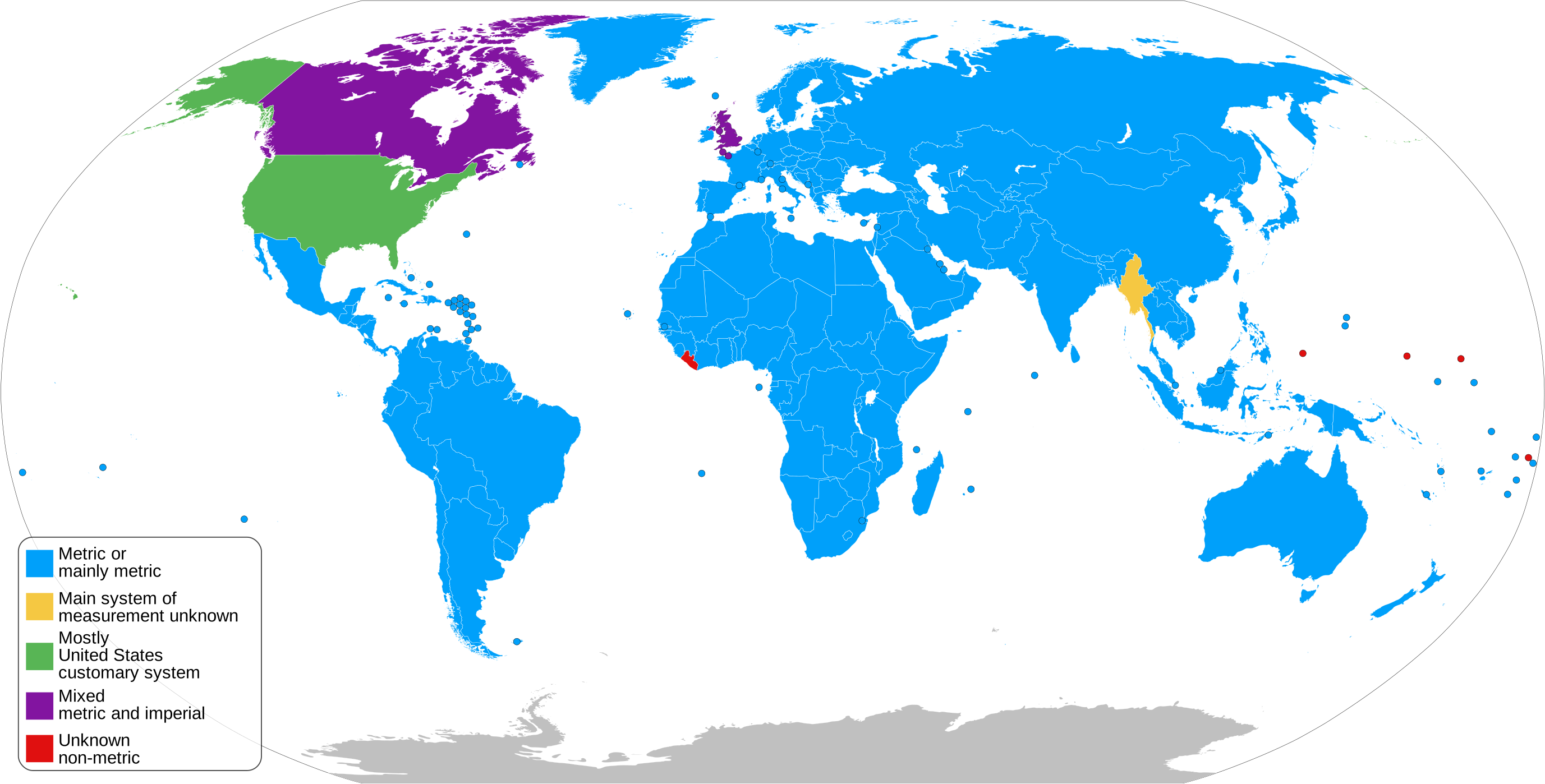
The United States is one of only three countries (along with Liberia and Myanmar) that have not, by default, adopted the International System of Units (SI) as their primary measurement system. While the metric system is mandated for use by federal agencies and is taught in schools, USCS remains dominant in everyday commerce and consumer products. For instance, the U.S. gallon is approximately 3.785 liters, while the imperial gallon is about 4.546 liters. A U.S. ton is typically 2,000 pounds (a short ton), whereas the metric tonne is 1,000 kilograms (approximately 2,205 pounds). The U.S. customary inch is defined as exactly 25.4 millimeters, a standard agreed upon internationally in 1959. Despite the prevalence of metric units in scientific and international contexts, an estimated 95% of Americans still use customary units for daily tasks. The construction industry, for example, predominantly uses feet and inches, with lumber often sold in nominal board feet.
👥 Key People & Organizations
While no single individual 'invented' the entire system, figures like Levi Woodbury, U.S. Secretary of the Treasury in the 1830s, played a crucial role in its standardization. The National Institute of Standards and Technology (NIST), formerly the National Bureau of Standards, is the primary U.S. government agency responsible for measurement standards, including the definitions and conversions related to USCS. Organizations like the American Society for Testing and Materials (ASTM) develop standards that often incorporate USCS. Historically, figures involved in trade and commerce during the colonial and early republic periods implicitly shaped the adoption and use of these units. The ongoing debate about metrication involves various advocacy groups, including the U.S. Metric Association, which promotes the adoption of SI units, and various industry bodies that rely on established USCS practices.
🌍 Cultural Impact & Influence
The cultural imprint of USCS is profound, permeating American vernacular and identity. Phrases like 'an inch closer,' 'a mile away,' or 'a pound of flesh' are woven into the fabric of the English language. Recipes from generations past are often written in cups, ounces, and Fahrenheit, creating a tangible link to culinary heritage. The visual landscape of the U.S. is also shaped by these units, from road signs displaying distances in miles to building dimensions often specified in feet and inches. This persistent use fosters a sense of familiarity and tradition, even as it presents challenges in international trade and scientific collaboration. The nickname 'freedom units' itself highlights the cultural and political significance attached to maintaining a distinct measurement system, often framed as a symbol of national independence.
⚡ Current State & Latest Developments
As of 2024, the dual-system reality persists. While the metric system is legally recognized and used in specific sectors like pharmaceuticals and automotive manufacturing, USCS remains the de facto standard for most consumer transactions and construction. NIST continues to provide guidance and maintain the precise definitions of USCS units in relation to SI. Efforts to increase metric usage, particularly in education and certain industries, continue, but widespread conversion faces significant economic and cultural hurdles. Recent legislative proposals or discussions around metrication occasionally surface, but none have gained sufficient traction to mandate a full transition. The ongoing global dominance of the metric system in science and international trade means that USCS will likely continue to exist alongside it, requiring dual labeling on many products.
🤔 Controversies & Debates
The most persistent controversy surrounding USCS is the ongoing debate over full metrication. Critics argue that the complexity of USCS, with its non-decimal conversions and differing liquid and dry measures, hinders international trade, complicates scientific research, and leads to costly errors. For example, the infamous Mars Climate Orbiter failure in 1999 was attributed to a mix-up between metric and customary units. Proponents of USCS, however, emphasize the deeply ingrained nature of these units in American culture, the significant cost and disruption associated with a full conversion, and the argument that 'freedom units' are a symbol of national identity. The 'nickname' of 'freedom units' itself is a point of contention, with some viewing it as a nationalistic and scientifically regressive stance, while others embrace it as a cultural identifier. The practical challenges of retraining the workforce and retooling industries are substantial arguments against a rapid shift.
🔮 Future Outlook & Predictions
The future of USCS is likely one of continued coexistence with the metric system, rather than a complete abandonment of customary units. As global trade and scientific collaboration intensify, the pressure to adopt SI will persist, particularly in industries with significant international engagement. We may see an increase in dual labeling and a greater emphasis on metric education in schools. However, the cultural inertia and economic investment in USCS infrastructure suggest that a full transition is improbable in the near to medium term. Future developments might involve incremental shifts in specific sectors or the development of more user-friendly conversion tools. The possibility of a future mandate for metrication remains, but it would require significant political will and public acceptance to overcome the deeply entrenched status quo. The question isn't if the metric system will gain ground, but at what pace and in which domains.
💡 Practical Applications
USCS finds practical application across a vast array of everyday activities in the United States. In construction, dimensions for lumber, rooms, and buildings are almost universally specified in feet and inches. Road signs display distances in miles and speed limits in miles per hour. Cooking and baking rely heavily on customary units like cups, ounces, and Fahrenheit for temperature. Retail pricing often uses dollars and cents, with quantities measured in pounds, ounces, or gallons. Even personal measurements, such as height in feet and inches and weight in pounds, fall under the USCS umbrella. While scientific laboratories and many manufacturing processes adhere to metric standards, the consumer-facing aspects of American life remain largely defined by customary units, from the gasoline pump to the grocery store shelf.
Key Facts
- Category
- science
- Type
- topic